
Image Transfer from Wilton Method - Course I - Building Buttercream Basics Joy Mettee Cake Decorating Classes, Baltimore, MD

Ravens Rose made from Modeling Chocolate Joy Mettee, Cake Decorating Classes, Baltimore, MD

Christmas Cake using techniques learned in Wilton Method Courses I and II. Joy Mettee, Cake Decorating Classes, Baltimore, MD
Image Transfer from Wilton Method - Course I - Building Buttercream Basics Joy Mettee Cake Decorating Classes, Baltimore, MD
What Did We Learn In Class 1?
-
How to bake a great cake
-
The importance of following recipe directions
-
The benefits of using quality baking pans
-
How to properly prepare a pan
-
The importance of accurate measuring
-
How to prevent a cake from forming a "dome" (using Bake-Even Strips)
-
How to test a cake for doneness
-
How to easily remove cakes from pans
-
How to make Class Buttercream Icing (recipe on page 9)
-
The characteristics of each icing ingredient
-
Icing consistency is the 1st of the 3 essentials of Decorating
-
There are 3 consistencies, Stiff, Medium and Thin
-
When to use each consistency
-
How to prepare decorating bags with couplers and tips
-
How to fill a decorating bag
-
We "burp" decorating bags because they will ALWAYS burp themselves when we don't want them to!
-
How to tort and fill a cake
-
How to ice a cake smooth
-
There are 6 tip "families"
-
What each family does
-
How to use the star tip
-
How to transfer a pattern using piping gel
-
Where to find easy patterns, coloring books, websites...google "easy line drawings"
-
How to perfect our techniques...PRACTICE, PRACTICE, PRACTICE
-
If something can go wrong it will!. Laugh it off and re-group!
Course I
Pictures
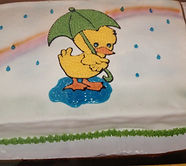
This cake uses techniques learned in Course I, class 1
Week 2
Drop Flowers




Week 3
Cupcakes


Week 4
Final Cakes

Shontae
Rosalind
What Did We Learn In Class 2?
-
With the proper consistency icing WILL crust.
-
If the icing is too thin it WILL NOT crust...EVER!
-
If the icing is too stiff it will not spread smoothly and will tear the cake.
-
If icing is not applied thick enough it will tear the cake.
-
If you apply too much pressure you will tear the cake.
-
Cakes tear a lot easier then we think!
-
You must wait (patiently) until a firm crust has developed before smoothing.
-
When adding the liquid to an icing recipe it is better to add 1 teaspoon at a time.
We can always add...we cannot take away!
When in doubt about your consistency, make it on the thick side and try
a small section/technique. If too thick, add more liquid.
-
The Second Essential of Decorating is Bag Position.
-
Bag Position refers to
The angle the bag is held...90* or 45*
The Direction to hold the back of the bag...3:00, 4:30 or 6:00 (9:00, 7:30
or 6:00 for "lefties")
-
The Third Essential of Decorating is Pressure Control
Pressure affects the size and uniformity of your design.
-
When your icing is not performing correctly take a deep breath, keep calm, Self Check:
Icing Consistency
Bag Position
Pressure Control
-
Jerky movements create jerky designs! Smooth and steady gets it right.
-
Stars should NOT be see-through! Let the icing build before lifting up.
-
A little bit of gel color goes a loooong way!
-
Liquid food coloring can be used in icing but it will water down the consistency. It may also separate in high humidity.
-
The heat of your hand will melt buttercream icing.
-
When piping a dot keep the tip buried in the icing until you release the pressure.
Practice makes perfect! Practice, Practice, Practice!
What Did We Learn In Class 3?
The cupcake was named such because they were originally baked in teacups! Cupcakes took less time to bake when hearth baking was the early oven.
-
The importance of self checking our Three Essentials:
-
Icing consistency
-
Bag position
-
Pressure control
-
Almost all problems can be traced to one of the above
-
How to make drop star and swirled flowers
-
The flowers don't look like much until they have a defined center dot!
-
How to make a rosette
-
The rosette should be piped on the center star, not around it
-
When piping the flowers above, the bag is held sideways.
-
How to pipe a shell border
-
There are several ways to pipe the shell border
-
How to use a flower nail
-
Thin icing is used for piping leaves
-
If the icing consistency is too stiff the leaves will crack or split
-
Stiff icing is really hard to pipe!
-
Icing can be thinned by adding water 1 teaspoon at a time
-
Icing can be thickened by adding additional powdered (10-X) sugar
-
The three types of leaves are basic, ruffled and stand-up.
-
The leaf tip is positioned with the two points vertical
-
Tip #230, the Bismarck tip is used to fill cupcakes, (eclairs and donuts too)
-
Tip #233, a specialty tip, is used to pipe mums, grass, hair and fur
-
Tip #233 can also be used to create a haystack!
Please leave feedback about your classes
What Did We Learn In Class 4?
Our work has really improved since that first week! We have made new friends who shared a common interest. Together we learned what fun cake decorating is!
We have learned:
* Use thin icing for piping words/letters to keep the lines from breaking
* We can thin icing with piping gel or corn syrup for more elasticity/less breaking
* How to use a flower nail
* How to make the ribbon rose
* To "self-check" when icing isn't cooperating
* To recognize the 3 different icing consistencies
* Which consistency is used for each decorating technique
* We should not ice a frozen cake.
* WE CAN DO ANYTHING IF WE SET OUR MINDS TO IT!